
Notes Vs Flashcards: Which Is Better For Retention?

It is a bit of a biological tragedy that our brains are so good at forgetting things soon after we learn about them. You can spend an entire day reading a textbook and highlighting the important parts, but by the time you go to bed, half of that information is already gone from your memory.
This rapid decay of memory is why so many students feel like they are starting from scratch every time they sit down to study.
Forgetting happens because our brains are naturally designed to clear out information that does not seem vital. If you want to remember things for the long haul, you have to find a way to prove to your brain that the information matters.
Students try to tackle this issue in their own ways. Two common techniques are note-taking and flashcards. But do these methods work? If yes, which one of them is better than the other for knowledge retention? Or should these two techniques be combined together for the best results?
In this article, we investigate these questions. Let’s start with note-taking and what research says about its effectiveness at knowledge retention.
TL;DR
Your brain forgets 50% of the new information after about an hour, and notes only capture about a third of what you hear. Flashcards beat notes for memory because they force active recall, especially with spaced repetition. But you need both: notes to understand, flashcards to remember. RemNote lets you do both in one place.
How much do we remember from taking notes?
We all have notebooks that we spent hours filling during school. Some of us might still be taking notes like that. But if you open notes from two years ago or even two days ago, you probably wouldn't remember half of what you noted down.
That’s because just writing something down doesn't make our brain store it in memory for a long time.
Then there’s a massive physical challenge of a speed gap that makes proper note-taking impossible. A group of researchers has found that we can only record about one-third of the important points from a lesson because we just can’t keep up with the speaker.
They found that most professors speak at an average rate of 120 to 180 words per minute. If you are writing by hand, you likely only manage to pen down about 22 words per minute. Even typing the notes digitally only gets you to about 33 words per minute.
The issue of the forgetting curve
The information you manage to note down in a lecture also starts to fade away from your memory the moment you leave the room.
This is due to the forgetting curve phenomenon that Hermann Ebbinghaus found through his research. He says that we lose about 50 percent of new information within just one hour. And after a full day has passed, that figure climbs to 70 percent. By the end of a single week, we have likely forgotten 90 percent of the material if we don’t actively try to retain it.
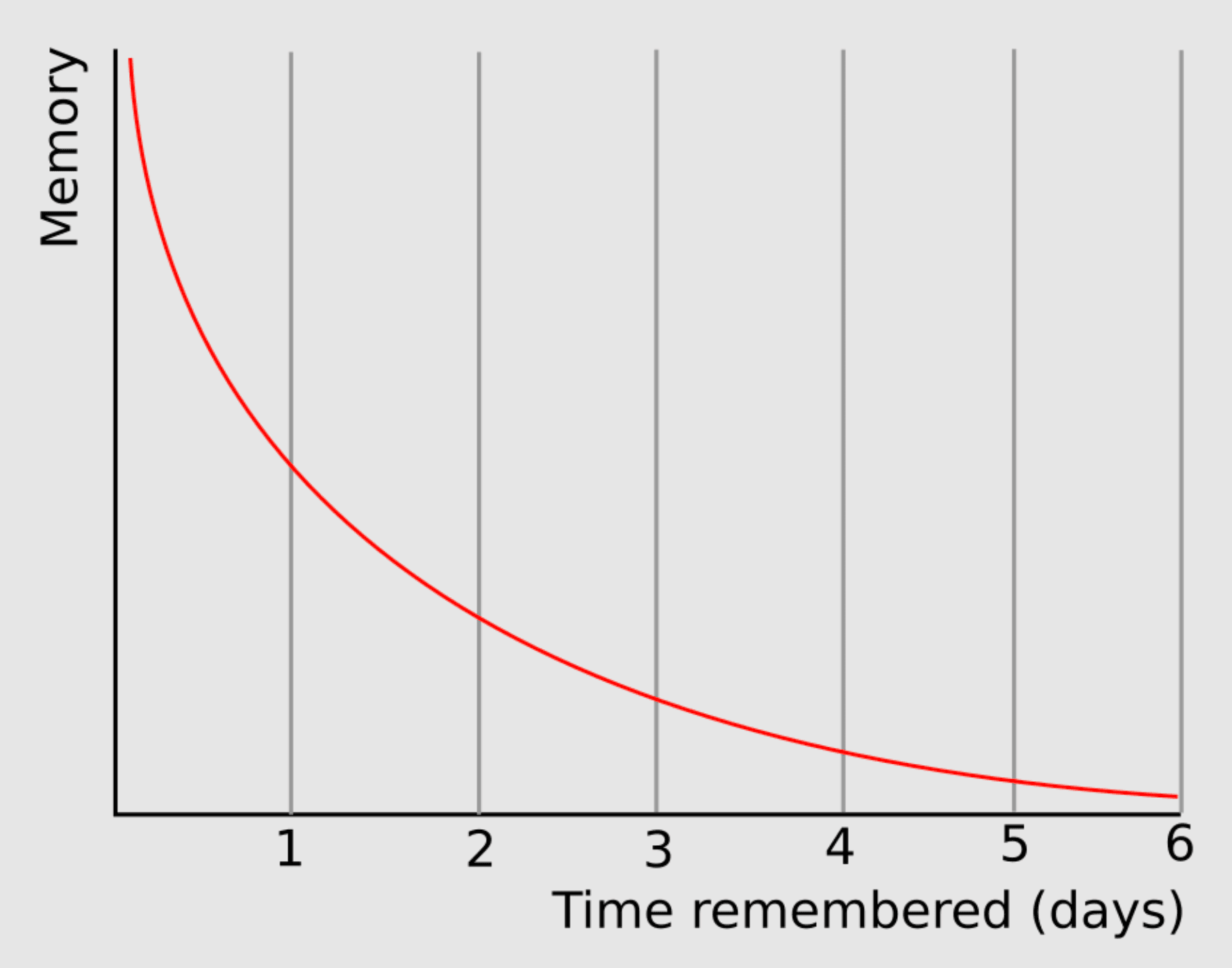
The Theory of Disuse explains why we forget things so fast. Our brain treats information as unimportant if it isn't being challenged to find the answer again.
You might think this only happens when you’re taking notes with a pen, and things might improve by taking notes on a tablet. But science doesn’t back that up either.
Researchers at the University of California compared medical students using tablets, laptops, and traditional pen and paper. The results showed no significant difference in how well students remembered facts or concepts, regardless of which method they chose.
Knowledge retention when using flashcards
Remember the Theory of Disuse? Our brain forgets inactive memories. The way to retain knowledge is through active recall of those memories, and flashcards are one of the best ways to practice active recall.
Even short sessions with flashcards can help you retain twice as much information compared to using traditional study methods (rereading notes, cramming, etc).
Flashcards make that possible by triggering a biological process called neural or memory consolidation.
When you put in effort to recall information from memory without flipping over a flashcard, your brain pushes that information from your weak short-term memory to your durable long-term memory, thus the term consolidation.
Repeat consolidation sessions can push information even deeper into your long-term memory.
The technique you use to study with flashcards is just as important.
Professor Bahrick from Ohio Wesleyan University once conducted an experiment where he and his family studied a new language together over five years using flashcards. They discovered that the best results didn't come from reviewing flashcards every day. Instead, they achieved their highest test scores on words that they reviewed only once every two months.
The technique the Bahrick family used is called spaced repetition. In this technique, you wait until you are right on the edge of forgetting a fact. Then you review the flashcard for that specific fact to send a signal to your mind that the information needs to be kept for the long haul.
Notes vs Flashcards: Which method is better for your grades?
It is normally perceived that note-taking makes a good student. But the hard data from university classrooms and elsewhere says otherwise. The data suggests that students should practice flashcards using the spaced repetition method for better knowledge retention.
Exam scores at the university
A team of researchers from the University of Leicester and the University of Leeds conducted a study to see how different study methods changed the final grades of the first-year undergraduate physics students.
To get accurate data, they even made a special app to track exactly how students prepared for their tests. The app would give students practice questions to attempt. The results showed that students who used spaced repetition achieved an average exam score of 70%.
And students who used traditional methods managed to reach 64%.
The gap between 70% and 64% score might seem small at first glance. But when you think about it, that 6 percent difference can turn a B grade into an A. The same research also found that students who had no specific study plan at all performed even worse, scoring 61% on average.
Success in high-stakes professional exams
We can see a similar pattern in professional fields where the stakes are much higher.
For example, doctors or medical students have to keep up with an immense amount of new knowledge while working full-time jobs or studying. They make one of the heaviest uses of flashcards and the spaced repetition technique to memorize complex knowledge in their field. And this seems to be helping them.
Between 2020 and 2023, a study followed over 26,000 family physicians to see how well they could implement new medical knowledge into their practice.
The physicians who used spaced repetition methods performed significantly better on knowledge assessments. They scored roughly 58 percent while their peers who did not use the technique only managed to reach 43 percent.
That 15-point margin shows that flashcard-based systems aren't just for high school students. They can help with complex professional subjects just as well.
The efficiency of digital flashcards
A big reason why flashcards are better than notes is that they are much more efficient with your time.
Flashcards have atomic information, which means they can be reviewed quickly whenever needed. On the other hand, you cannot say the same for reading your notes. Most notes are typed/penned in a hurry, and they can lack the information that you need to study.
Despite everything, note-taking is still an essential part of learning because it helps you first understand a topic.
You cannot skip note-taking and go straight to flashcards. Even if you try to do that, you will be memorizing things you don't properly comprehend. Flashcards, by design, aren’t something you can practice right away.
But flashcard reviews still need to be started soon, once you have understood a concept. You cannot start them the night before an exam. Instead, you should start them well in advance.
Why you should use notes and flashcards together
While flashcards are better than notes for long-term knowledge retention, the comparison between the two is not fair. The two tools serve different purposes, to begin with.
So choosing between the two is akin to picking a side in a war that doesn't exist.
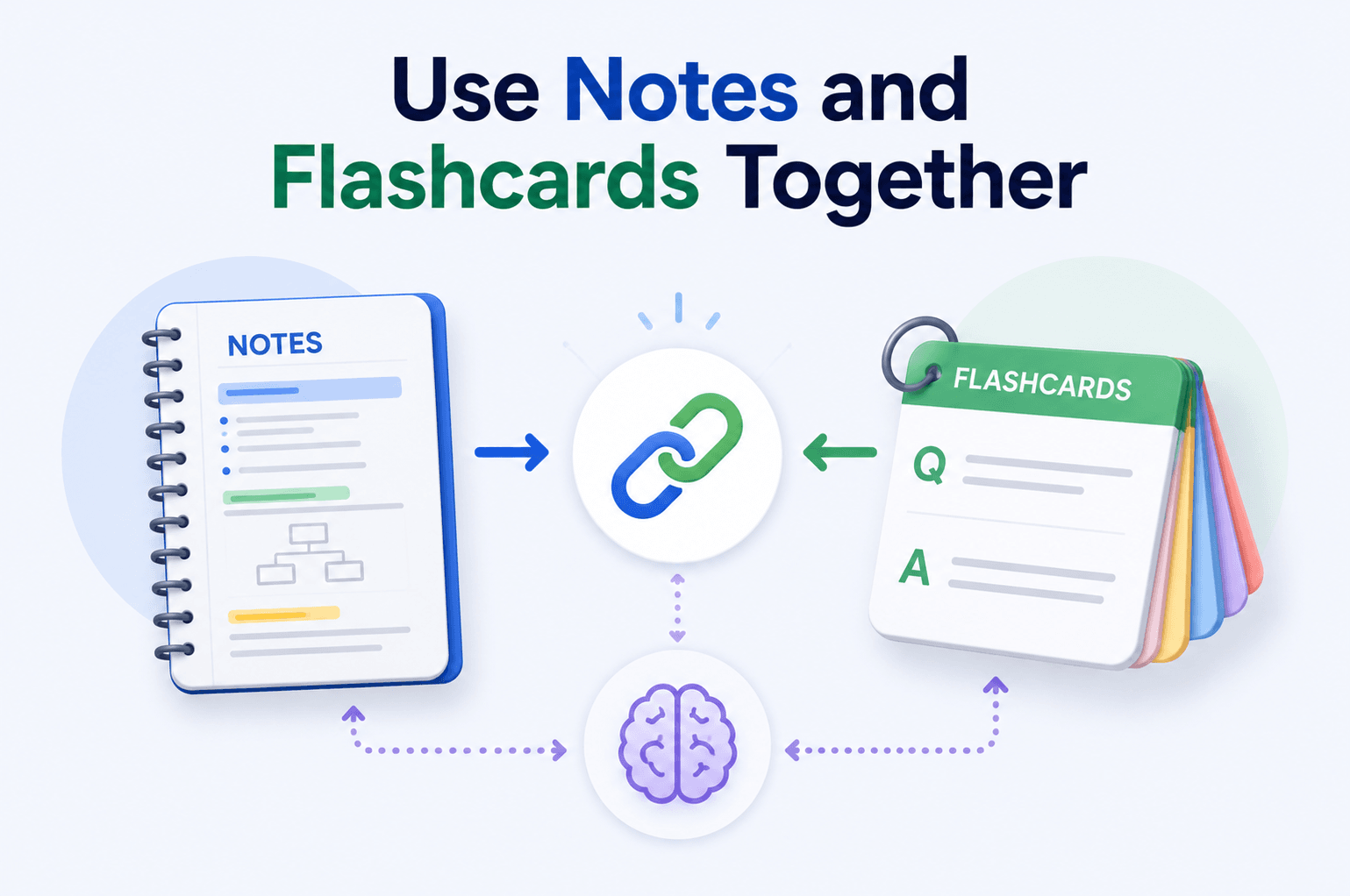
Why pick one and leave the other when they can be a part of a single system? You can use note-taking to build the foundation of concepts and flashcards to remember those concepts over time.
The keyword here is “remember.” Flashcards can only help you remember things you’ve already read or studied about. In other words, you cannot use them to understand entire concepts.
That needs to be done using a different medium and prior to using flashcards. And notes are a good medium for that. Not just the notes you take during a lecture, but also the notes you take during personal practice.
If you start using flashcards too soon without taking notes first, your learning often becomes fragmented because you remember the pieces but not the whole picture.
In other words, notes are your map of the terrain. If you try to memorize stuff using flashcards without first having a sound understanding of concepts, you’ll be hiking through the woods without a compass.
How to implement a note-taking + flashcards routine
Here’s how you can combine note-taking and flashcards in a single routine:
- Get a good grip on concepts in your messy notes to make sure you truly understand the logic before you try to memorize anything.
- Distill those notes into atomic question-and-answer pairs and create flashcards.
- Use spaced repetition to review those cards so the information stays in your long-term memory for years.
- Refer to your original notes if you find yourself struggling with a specific card to see the original context again.
Remember, while note-taking is essential, you cannot rely on it alone. Flashcards are just as important.
Using only notes can lead to the fluency illusion, where people confuse familiarity with memorization. They think that because they have read their notes a number of times or written them multiple times, they have memorized everything. But that’s just recognition, which is a very different thing from true recall.
RemNote makes notes and flashcards work as one
Researchers at the University of Wisconsin-Madison spent five years observing learning strategies that students choose for themselves and their beliefs about the strategies' effectiveness.
They found that most students actually know that flashcards are an effective tool, giving them a score of 7.09 out of 10. In contrast, they viewed copying or rewriting notes much more critically, giving that habit a score of only 5.24.
But even though they knew flashcards were better, they still weren’t using them. There was a major mismatch between what most of them believed and what they actually did.
They reported using their notes far more frequently, with an 8.15 rating, compared to just 5.12 for using flashcards. When the researchers asked the reason for not using flashcards, nearly 50% of the participants said they simply didn't have enough time. Another 19.6% pointed out that they lacked the right resources or tools to make the switch.
That’s understandable because creating physical flashcards and sometimes even digital ones is a time-consuming hassle without the right tools and guidance.
But with flashcard makers like RemNote, you can put an end to that hassle.
RemNote bridges the gap between note-taking and memory retention without forcing you to spend extra hours preparing. You can take notes inside RemNote and turn those notes into flashcards, too.
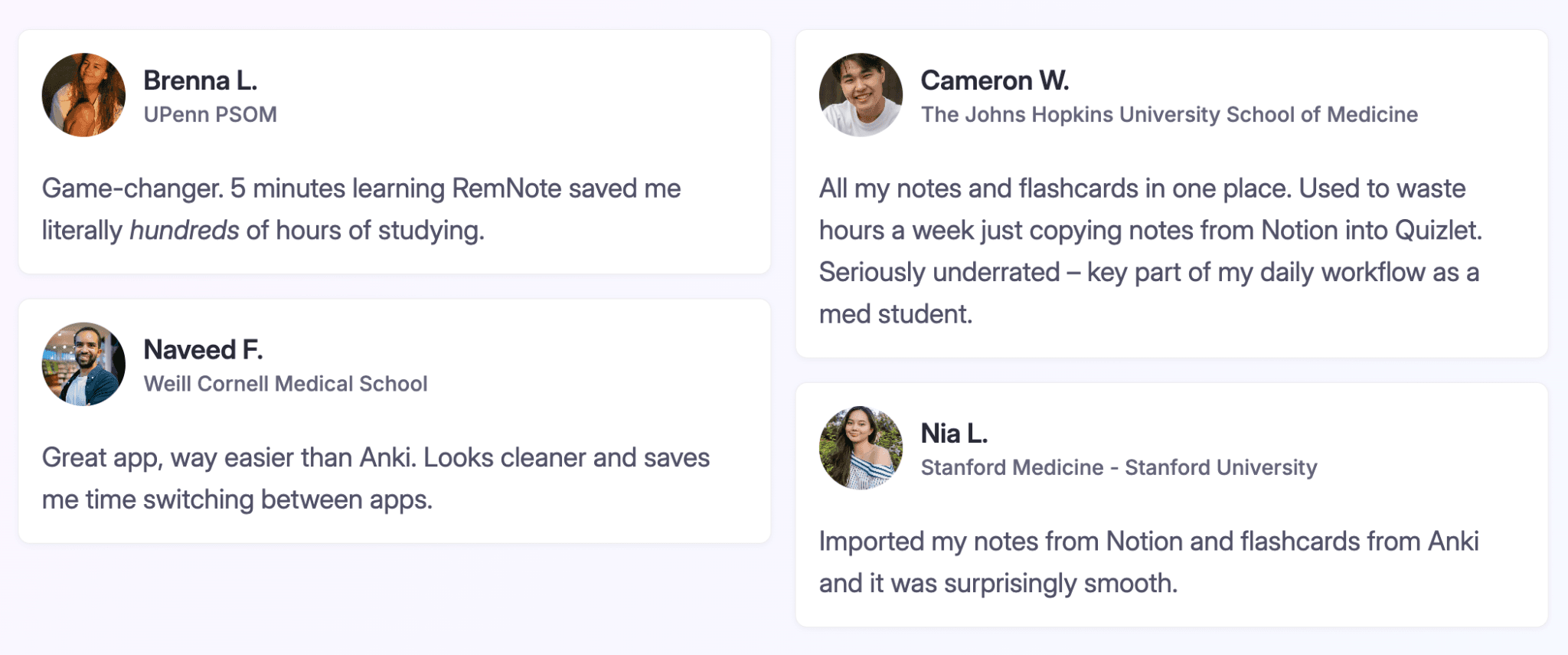
The entire note-taking + flashcards routine you read about above can be implemented using RemNote. Here’s how:
- Take your notes inside RemNote (or upload them) and convert them into flashcards using simple instructions.
- The app organizes and schedules flashcard reviews for you.
- Every card maintains a link to your original notes. You can trace back specific facts and find their detailed context in your notes with just a click.
RemNote is one of the few tools that don’t make you choose between flashcards and notes. It allows you to do both and also removes the barriers of time and effort. A big advantage is that you don’t have to use two separate apps for note-taking and flashcards.
There’s a reason why 1,000,000+ students worldwide use it (to get higher grades 🤫).